
M3EM Studio Suite leverages Finite Integration Technique (FIT)
with GPU-native cloud acceleration for 10-100x faster simulations
Combining cutting-edge algorithms with hardware acceleration for next-gen EM simulation
Based on time-domain Finite Integration Technique (FIT), deeply integrated with conformal mesh technology ACE*, supporting hundreds of millions of mesh cells for fine solution, ensuring simulation results closely match measured data.
Adopting advanced GPU hardware acceleration architecture, achieving 100x+ solution speedup*, reducing complex model simulation cycles from days to hours, significantly improving engineering iteration efficiency.
Based on high-precision field-circuit coupling algorithms, providing efficient and stable synchronous/asynchronous field-circuit co-simulation capabilities, fully leveraging GPU hardware acceleration advantages.
M3EM Macro integrates passivity, causality and reciprocity intelligent detection and repair. Built-in advanced fitting algorithms support multiple macro model types and automatic SPICE model generation.
Complete pre/post-processing toolset supporting automated workflow orchestration and customized secondary development, enabling efficient simulation data management, visualization and deep analysis.
From 5G communications to satellite internet, providing reliable simulation support for innovative applications

For smart terminals such as smartphones, tablets/PCs, and wearable devices, providing refined modeling and simulation from board-level, module-level to complex full-device-level. Capable of evaluating interconnect, antenna, and EMI/EMC performance and risks, significantly shortening design iteration cycles and improving design quality.

For 5G base stations, small cells, and indoor distribution systems, supporting large-scale MIMO antenna array simulation and optimization. Capable of analyzing beamforming, coverage range, and interference characteristics, helping operators achieve network optimization deployment.

For advanced packaging designs such as 2.5D/3D IC and Chiplet heterogeneous integration, providing full-chain electromagnetic field simulation capabilities. Supports cross-scale collaborative modeling from sub-micron to centimeter-level packaging systems.

Focus on in-vehicle antenna design and full-vehicle EMC performance verification. Capable of accurately predicting the distortion effect of vehicle body metal frame on antenna radiation patterns, achieving optimal antenna layout design.

For communication systems and phased array radar design, supporting one-dimensional/two-dimensional large-scale array modeling and beam optimization. Capable of analyzing array coupling, scanning characteristics, and radar detection performance.
For satellite communications, spacecraft, and UAV systems, supporting electromagnetic compatibility simulation of spaceborne antennas, ground terminals, and airborne radar. Capable of analyzing antenna layout, electromagnetic interference, and electromagnetic environment effects.
Real simulation projects from different industries, validating M3EM Studio's exceptional performance




In package substrate interconnect design, S-parameters are core indicators for evaluating signal integrity. This case details the complete workflow from importing, modeling to simulation solving of signal networks (Cadence Allegro) using M3EM Studio. Finally, by comparing M3EM Studio's simulation results with benchmark software, the simulation accuracy of M3EM Studio in this application scenario is validated.
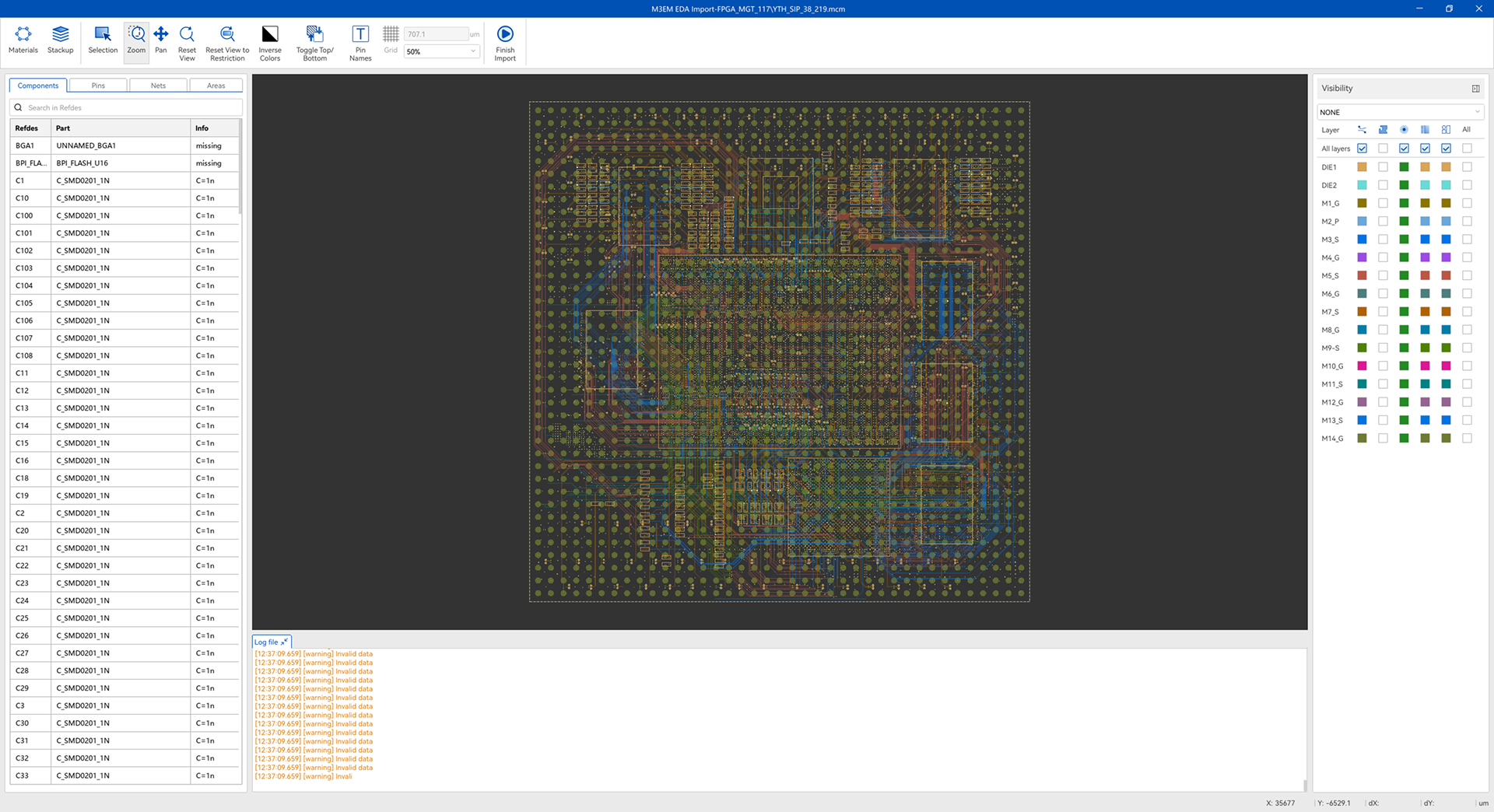
M3EM EDA Import Interface
This case takes a 5G smartphone full device (including detailed PCB traces and vias) as the object, presenting the complete refined simulation workflow from model import to result analysis. By accurately simulating the electromagnetic environment between metal frames and complex components, it quickly outputs key indicators such as S-parameters, antenna gain, and radiation efficiency, helping engineers accurately locate interference sources and optimize antenna layout in the early design stage, significantly reducing prototype iterations, providing a high-precision and high-efficiency full-device antenna simulation solution for 5G terminals.
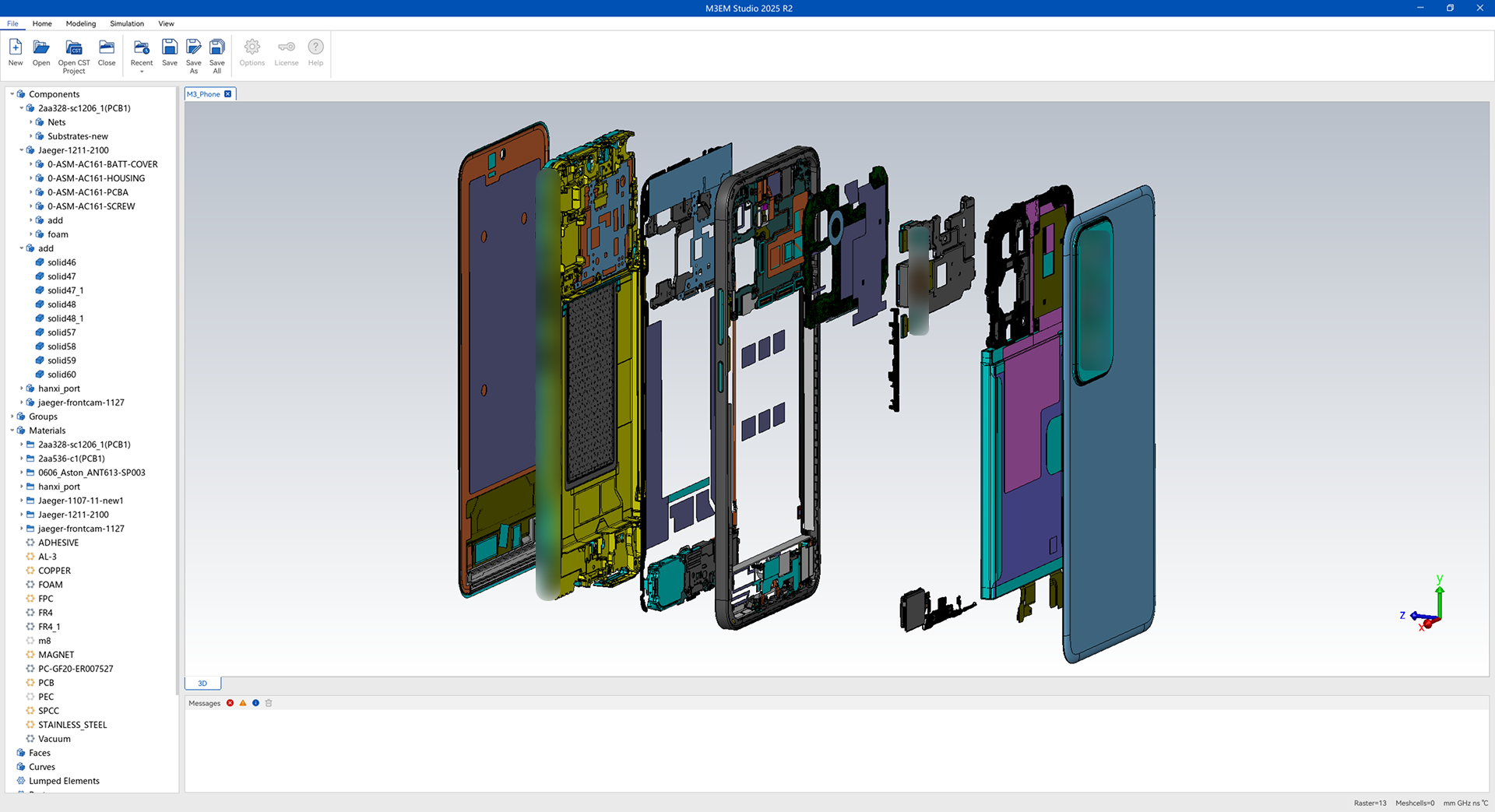
Phone Exploded View
In automotive antenna development, after component-level design verification (DV) is completed, vehicle testing often encounters key indicator deviations such as radiation efficiency and pattern due to the complex electromagnetic environment of the vehicle (such as metal shielding, cavity resonance, glass/interior dielectric loss, and multi-antenna interference), bringing risks of performance non-compliance. M3EM Studio successfully solves the cross-scale simulation modeling challenge from micro-scale components to large vehicle bodies, accurately evaluates the electromagnetic performance of antenna modules in complex vehicle environments, outputs key parameters such as S-parameters, radiation efficiency and gain, avoids interference hazards in advance, and supports rapid iterative optimization of antenna systems.
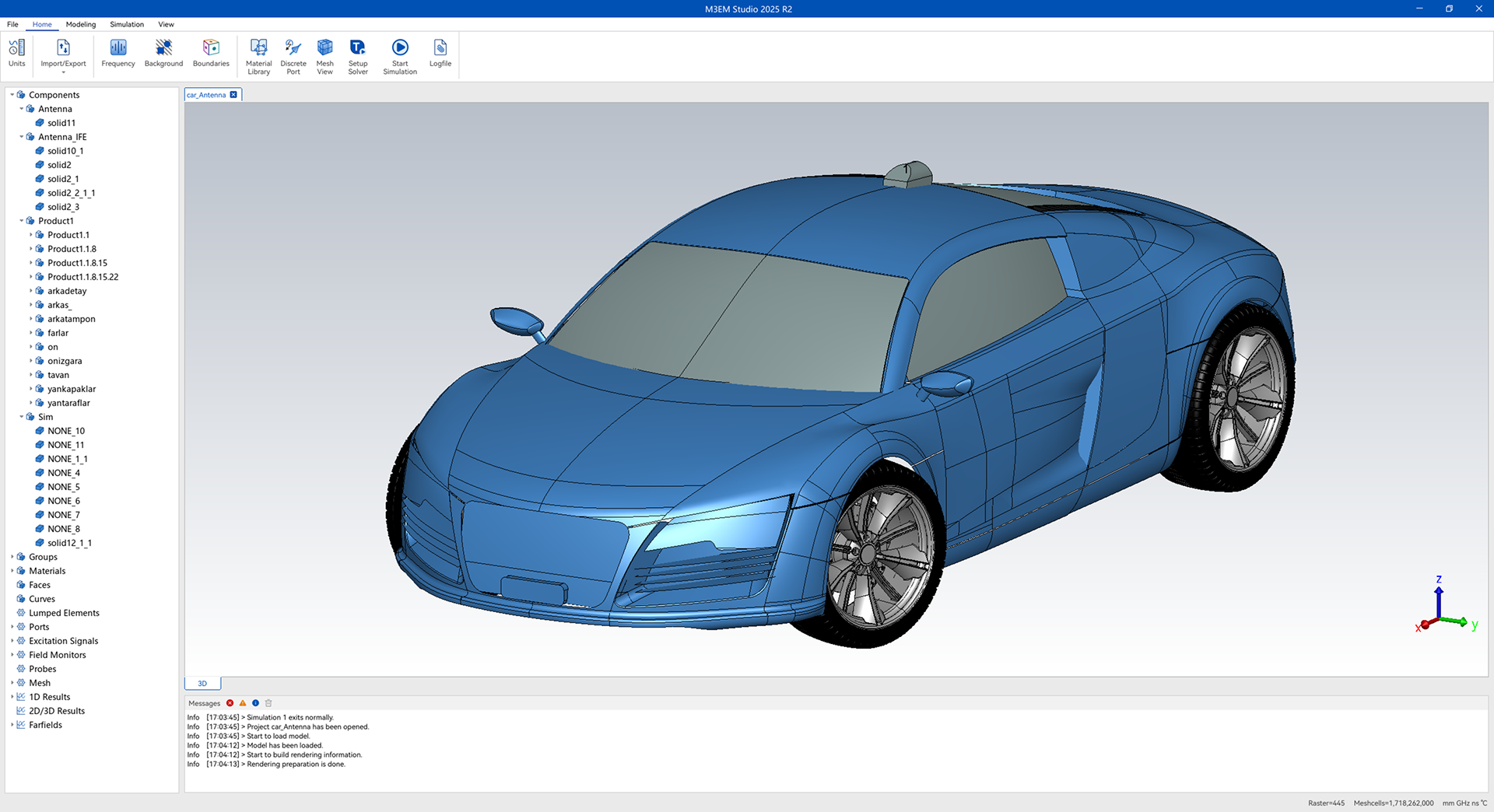
Automotive Radar Model
Frequency Selective Surface (FSS) is widely used in satellite communications and millimeter-wave radar systems, enabling electromagnetic control of specific frequency bands in complex electromagnetic environments. Traditional finite difference methods cause resonance frequency point shifts due to staircase errors, unable to accurately characterize their frequency-dependent characteristics. M3EM Studio software, with its unique Advanced Conformal Enhancement (ACE) technology, avoids staircase errors from traditional finite difference methods, models and simulates FSS transmission array structures with complex Minkowski fractal units, studying the impact of this structure on antenna S-parameters and far-field radiation patterns.
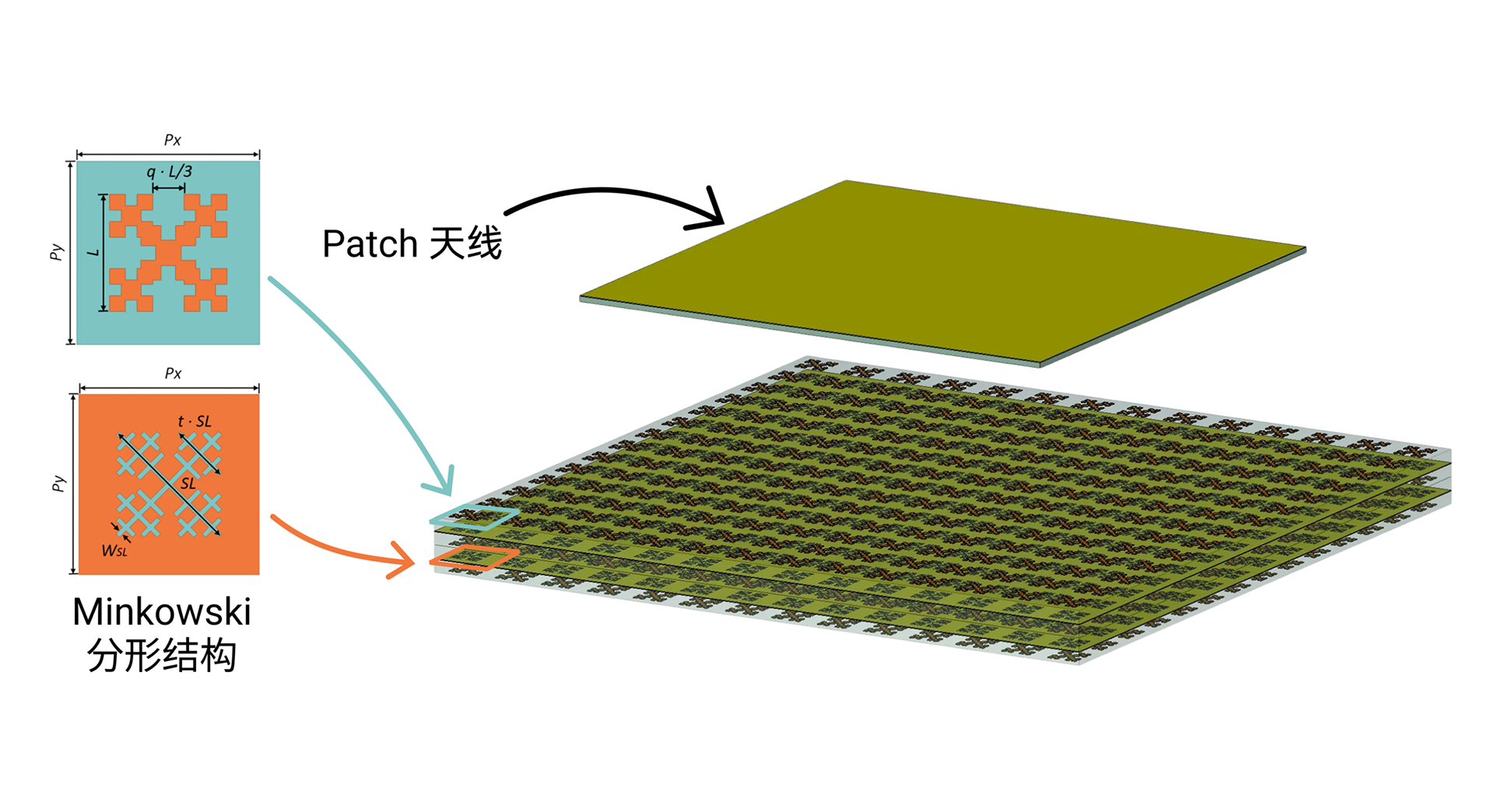
Patch Antenna and FSS Array Structure
Working with industry leaders to advance EM simulation technology
Request a trial of M3EM Studio and experience GPU-accelerated EM simulation

Scan QR code to follow "3rd Paradigm" for latest updates